MoreExam
1. Question Content...
EXPLANATION
Answer: X - EXPLANATION Content.
Question1: You work for a delivery company. You need to design a system that stores and manages features such as parcels delivered and truck locations over time. The system must retrieve the features with low latency and feed those features into a model for online prediction. The data science team will retrieve historical data at a specific point in time for model training. You want to store the features with minimal effort. What should you do?
Question2: You need to execute a batch prediction on 100 million records in a BigQuery table with a custom TensorFlow DNN regressor model, and then store the predicted results in a BigQuery table. You want to minimize the effort required to build this inference pipeline. What should you do?
Question3: You are developing an ML model that predicts the cost of used automobiles based on data such as location, condition model type color, and engine-'battery efficiency. The data is updated every night Car dealerships will use the model to determine appropriate car prices. You created a Vertex Al pipeline that reads the data splits the data into training/evaluation/test sets performs feature engineering trains the model by using the training dataset and validates the model by using the evaluation dataset. You need to configure a retraining workflow that minimizes cost What should you do?
Question4: Your work for a textile manufacturing company. Your company has hundreds of machines and each machine has many sensors. Your team used the sensory data to build hundreds of ML models that detect machine anomalies Models are retrained daily and you need to deploy these models in a cost-effective way. The models must operate 24/7 without downtime and make sub millisecond predictions. What should you do?
Question5: You work for an online publisher that delivers news articles to over 50 million readers. You have built an AI model that recommends content for the company's weekly newsletter. A recommendation is considered successful if the article is opened within two days of the newsletter's published date and the user remains on the page for at least one minute.All the information needed to compute the success metric is available in BigQuery and is updated hourly. The model is trained on eight weeks of data, on average its performance degrades below the acceptable baseline after five weeks, and training time is 12 hours. You want to ensure that the model's performance is above the acceptable baseline while minimizing cost. How should you monitor the model to determine when retraining is necessary?
Question6: You are building a model to predict daily temperatures. You split the data randomly and then transformed the training and test datasets. Temperature data for model training is uploaded hourly. During testing, your model performed with 97% accuracy; however, after deploying to production, the model's accuracy dropped to 66%.How can you make your production model more accurate?
Question7: You are investigating the root cause of a misclassification error made by one of your models. You used Vertex Al Pipelines to tram and deploy the model. The pipeline reads data from BigQuery. creates a copy of the data in Cloud Storage in TFRecord format trains the model in Vertex Al Training on that copy, and deploys the model to a Vertex Al endpoint. You have identified the specific version of that model that misclassified: and you need to recover the data this model was trained on. How should you find that copy of the data'?
Question8: Your data science team needs to rapidly experiment with various features, model architectures, and hyperparameters. They need to track the accuracy metrics for various experiments and use an API to query the metrics over time. What should they use to track and report their experiments while minimizing manual effort?
Question9: You work for an advertising company and want to understand the effectiveness of your company's latest advertising campaign. You have streamed 500 MB of campaign data into BigQuery. You want to query the table, and then manipulate the results of that query with a pandas dataframe in an Al Platform notebook. What should you do?
Question10: You are building a TensorFlow model for a financial institution that predicts the impact of consumer spending on inflation globally. Due to the size and nature of the data, your model is long-running across all types of hardware, and you have built frequent checkpointing into the training process. Your organization has asked you to minimize cost. What hardware should you choose?
Question11: You developed a custom model by using Vertex Al to predict your application's user churn rate You are using Vertex Al Model Monitoring for skew detection The training data stored in BigQuery contains two sets of features - demographic and behavioral You later discover that two separate models trained on each set perform better than the original model You need to configure a new model mentioning pipeline that splits traffic among the two models You want to use the same prediction-sampling-rate and monitoring-frequency for each model You also want to minimize management effort What should you do?
Question12: You are an ML engineer at a global shoe store. You manage the ML models for the company's website. You are asked to build a model that will recommend new products to the user based on their purchase behavior and similarity with other users. What should you do?
Question13: You are training a deep learning model for semantic image segmentation with reduced training time. While using a Deep Learning VM Image, you receive the following error: The resource'projects/deeplearning-platforn/zones/europe-west4-c/acceleratorTypes/nvidia-tesla-k80' was not found. What should you do?
Question14: You need to develop a custom TensorRow model that will be used for online predictions. The training data is stored in BigQuery. You need to apply instance-level data transformations to the data for model training and serving. You want to use the same preprocessing routine during model training and serving. How should you configure the preprocessing routine?
Question15: You are creating a social media app where pet owners can post images of their pets. You have one million user uploaded images with hashtags. You want to build a comprehensive system that recommends images to users that are similar in appearance to their own uploaded images.What should you do?
Question16: You have deployed a model on Vertex AI for real-time inference. During an online prediction request, you get an "Out of Memory" error. What should you do?
Question17: You work on a growing team of more than 50 data scientists who all use AI Platform. You are designing a strategy to organize your jobs, models, and versions in a clean and scalable way. Which strategy should you choose?
Question18: You work for the AI team of an automobile company, and you are developing a visual defect detection model using TensorFlow and Keras. To improve your model performance, you want to incorporate some image augmentation functions such as translation, cropping, and contrast tweaking. You randomly apply these functions to each training batch. You want to optimize your data processing pipeline for run time and compute resources utilization. What should you do?
Question19: You recently trained a XGBoost model that you plan to deploy to production for online inference Before sending a predict request to your model's binary you need to perform a simple data preprocessing step This step exposes a REST API that accepts requests in your internal VPC Service Controls and returns predictions You want to configure this preprocessing step while minimizing cost and effort What should you do?
Question20: You are developing a recommendation engine for an online clothing store. The historical customer transaction data is stored in BigQuery and Cloud Storage. You need to perform exploratory data analysis (EDA), preprocessing and model training. You plan to rerun these EDA, preprocessing, and training steps as you experiment with different types of algorithms. You want to minimize the cost and development effort of running these steps as you experiment. How should you configure the environment?
Question21: You are a data scientist at an industrial equipment manufacturing company. You are developing a regression model to estimate the power consumption in the company's manufacturing plants based on sensor data collected from all of the plants. The sensors collect tens of millions of records every day. You need to schedule daily training runs foryour model that use all the data collected up to the current date. You want your model to scale smoothly and require minimal development work. What should you do?
Question22: You are an ML engineer on an agricultural research team working on a crop disease detection tool to detect leaf rust spots in images of crops to determine the presence of a disease. These spots, which can vary in shape and size, are correlated to the severity of the disease. You want to develop a solution that predicts the presence and severity of the disease with high accuracy. What should you do?
Question23: You work for a large social network service provider whose users post articles and discuss news. Millions of comments are posted online each day, and more than 200 human moderators constantly review comments and flag those that are inappropriate. Your team is building an ML model to help human moderators check content on the platform. The model scores each comment and flags suspicious comments to be reviewed by a human.Which metric(s) should you use to monitor the model's performance?
Question24: You work for a retailer that sells clothes to customers around the world. You have been tasked with ensuring that ML models are built in a secure manner. Specifically, you need to protect sensitive customer data that might be used in the models. You have identified four fields containing sensitive data that are being used by your data science team: AGE, IS_EXISTING_CUSTOMER, LATITUDE_LONGITUDE, and SHIRT_SIZE.What should you do with the data before it is made available to the data science team for training purposes?
Question25: You have created a Vertex Al pipeline that includes two steps. The first step preprocesses 10 TB data completes in about 1 hour, and saves the result in a Cloud Storage bucket The second step uses the processed data to train a model You need to update the model's code to allow you to test different algorithms You want to reduce pipeline execution time and cost, while also minimizing pipeline changes What should you do?
Question26: You need to build an ML model for a social media application to predict whether a user's submitted profile photo meets the requirements. The application will inform the user if the picture meets the requirements. How should you build a model to ensure that the application does not falsely accept a non-compliant picture?
Question27: You want to rebuild your ML pipeline for structured data on Google Cloud. You are using PySpark to conduct data transformations at scale, but your pipelines are taking over 12 hours to run. To speed up development and pipeline run time, you want to use a serverless tool and SQL syntax. You have already moved your raw data into Cloud Storage. How should you build the pipeline on Google Cloud while meeting the speed and processing requirements?
Question28: You developed a custom model by using Vertex Al to forecast the sales of your company s products based on historical transactional data You anticipate changes in the feature distributions and the correlations between the features in the near future You also expect to receive a large volume of prediction requests You plan to use Vertex Al Model Monitoring for drift detection and you want to minimize the cost. What should you do?
Question29: Your team frequently creates new ML models and runs experiments. Your team pushes code to a single repository hosted on Cloud Source Repositories. You want to create a continuous integration pipeline that automatically retrains the models whenever there is any modification of the code. What should be your first step to set up the CI pipeline?
Question30: You lead a data science team at a large international corporation. Most of the models your team trains are large-scale models using high-level TensorFlow APIs on AI Platform with GPUs. Your team usually takes a few weeks or months to iterate on a new version of a model. You were recently asked to review your team's spending. How should you reduce your Google Cloud compute costs without impacting the model's performance?
Question31: You work for a public transportation company and need to build a model to estimate delay times for multiple transportation routes. Predictions are served directly to users in an app in real time. Because different seasons and population increases impact the data relevance, you will retrain the model every month. You want to follow Google-recommended best practices. How should you configure the end-to-end architecture of the predictive model?
Question32: You are developing a model to identify traffic signs in images extracted from videos taken from the dashboard of a vehicle. You have a dataset of 100 000 images that were cropped to show one out of ten different traffic signs. The images have been labeled accordingly for model training and are stored in a Cloud Storage bucket You need to be able to tune the model during each training run. How should you train the model?
Question33: You need to build classification workflows over several structured datasets currently stored in BigQuery.Because you will be performing the classification several times, you want to complete the following steps without writing code: exploratory data analysis, feature selection, model building, training, and hyperparameter tuning and serving. What should you do?
Question34: You work for a global footwear retailer and need to predict when an item will be out of stock based on historical inventory data. Customer behavior is highly dynamic since footwear demand is influenced by many different factors. You want to serve models that are trained on all available data, but track your performance on specific subsets of data before pushing to production. What is the most streamlined and reliable way to perform this validation?
Question35: You work as an ML engineer at a social media company, and you are developing a visual filter for users' profile photos. This requires you to train an ML model to detect bounding boxes around human faces. You want to use this filter in your company's iOS-based mobile phone application. You want to minimize code development and want the model to be optimized for inference on mobile phones. What should you do?
Question36: You work for a company that is developing an application to help users with meal planning You want to use machine learning to scan a corpus of recipes and extract each ingredient (e g carrot, rice pasta) and each kitchen cookware (e.g. bowl, pot spoon) mentioned Each recipe is saved in an unstructured text file What should you do?
Question37: Your team has been tasked with creating an ML solution in Google Cloud to classify support requests for one of your platforms. You analyzed the requirements and decided to use TensorFlow to build the classifier so that you have full control of the model's code, serving, and deployment. You will use Kubeflow pipelines for the ML platform. To save time, you want to build on existing resources and use managed services instead of building a completely new model. How should you build the classifier?
Question38: You work at a large organization that recently decided to move their ML and data workloads to Google Cloud.The data engineering team has exported the structured data to a Cloud Storage bucket in Avro format. You need to propose a workflow that performs analytics, creates features, and hosts the features that your ML models use for online prediction How should you configure the pipeline?
Question39: You need to design a customized deep neural network in Keras that will predict customer purchases based on their purchase history. You want to explore model performance using multiple model architectures, store training data, and be able to compare the evaluation metrics in the same dashboard. What should you do?
Question40: You are building a MLOps platform to automate your company's ML experiments and model retraining. You need to organize the artifacts for dozens of pipelines How should you store the pipelines' artifacts'?
Question41: You recently deployed a scikit-learn model to a Vertex Al endpoint You are now testing the model on live production traffic While monitoring the endpoint. you discover twice as many requests per hour than expected throughout the day You want the endpoint to efficiently scale when the demand increases in the future to prevent users from experiencing high latency What should you do?
Question42: You work for a large hotel chain and have been asked to assist the marketing team in gathering predictions for a targeted marketing strategy. You need to make predictions about user lifetime value (LTV) over the next 30 days so that marketing can be adjusted accordingly. The customer dataset is in BigQuery, and you are preparing the tabular data for training with AutoML Tables. This data has a time signal that is spread across multiple columns. How should you ensure that AutoML fits the best model to your data?
Question43: You work for a rapidly growing social media company. Your team builds TensorFlow recommender models in an on-premises CPU cluster. The data contains billions of historical user events and 100 000 categorical features. You notice that as the data increases the model training time increases. You plan to move the models to Google Cloud You want to use the most scalable approach that also minimizes training time. What should you do?
Question44: You are training a TensorFlow model on a structured data set with 100 billion records stored in several CSV files. You need to improve the input/output execution performance. What should you do?
Question45: You recently trained an XGBoost model on tabular data You plan to expose the model for internal use as an HTTP microservice After deployment you expect a small number of incoming requests. You want to productionize the model with the least amount of effort and latency. What should you do?
Question46: You work for a bank You have been asked to develop an ML model that will support loan application decisions. You need to determine which Vertex Al services to include in the workflow You want to track the model's training parameters and the metrics per training epoch. You plan to compare the performance of each version of the model to determine the best model based on your chosen metrics. Which Vertex Al services should you use?
Question47: You work for a food product company. Your company's historical sales data is stored in BigQuery You need to use Vertex Al's custom training service to train multiple TensorFlow models that read the data from BigQuery and predict future sales You plan to implement a data preprocessing algorithm that performs min-max scaling and bucketing on a large number of features before you start experimenting with the models.You want to minimize preprocessing time, cost and development effort How should you configure this workflow?
Question48: You work for a toy manufacturer that has been experiencing a large increase in demand. You need to build an ML model to reduce the amount of time spent by quality control inspectors checking for product defects.Faster defect detection is a priority. The factory does not have reliable Wi-Fi. Your company wants to implement the new ML model as soon as possible. Which model should you use?
Question49: You have developed a BigQuery ML model that predicts customer churn and deployed the model to Vertex Al Endpoints. You want to automate the retraining of your model by using minimal additional code when model feature values change. You also want to minimize the number of times that your model is retrained to reduce training costs. What should you do?
Question50: You want to train an AutoML model to predict house prices by using a small public dataset stored in BigQuery. You need to prepare the data and want to use the simplest most efficient approach. What should you do?
Question51: You built a custom ML model using scikit-learn. Training time is taking longer than expected. You decide to migrate your model to Vertex AI Training, and you want to improve the model's training time. What should you try out first?
Question52: You work on the data science team at a manufacturing company. You are reviewing the company's historical sales data, which has hundreds of millions of records. For your exploratory data analysis, you need to calculate descriptive statistics such as mean, median, and mode; conduct complex statistical tests for hypothesis testing; and plot variations of the features over time You want to use as much of the sales data as possible in your analyses while minimizing computational resources. What should you do?
Question53: You are creating a deep neural network classification model using a dataset with categorical input values.Certain columns have a cardinality greater than 10,000 unique values. How should you encode these categorical values as input into the model?
Question54: You have a large corpus of written support cases that can be classified into 3 separate categories: Technical Support, Billing Support, or Other Issues. You need to quickly build, test, and deploy a service that will automatically classify future written requests into one of the categories. How should you configure the pipeline?
Question55: You are creating a model training pipeline to predict sentiment scores from text-based product reviews. You want to have control over how the model parameters are tuned, and you will deploy the model to an endpoint after it has been trained You will use Vertex Al Pipelines to run the pipeline You need to decide which Google Cloud pipeline components to use What components should you choose?
Question56: You have a custom job that runs on Vertex Al on a weekly basis The job is Implemented using a proprietary ML workflow that produces the datasets. models, and custom artifacts, and sends them to a Cloud Storage bucket Many different versions of the datasets and models were created Due to compliance requirements, your company needs to track which model was used for making a particular prediction, and needs access to the artifacts for each model. How should you configure your workflows to meet these requirement?
Question57: You have deployed a scikit-learn model to a Vertex Al endpoint using a custom model server. You enabled auto scaling; however, the deployed model fails to scale beyond one replica, which led to dropped requests.You notice that CPU utilization remains low even during periods of high load. What should you do?
Question58: You are an ML engineer in the contact center of a large enterprise. You need to build a sentiment analysis tool that predicts customer sentiment from recorded phone conversations. You need to identify the best approach to building a model while ensuring that the gender, age, and cultural differences of the customers who called the contact center do not impact any stage of the model development pipeline and results. What should you do?
Question59: You manage a team of data scientists who use a cloud-based backend system to submit training jobs. This system has become very difficult to administer, and you want to use a managed service instead. The data scientists you work with use many different frameworks, including Keras, PyTorch, theano. Scikit-team, and custom libraries. What should you do?
Question60: You have deployed multiple versions of an image classification model on Al Platform. You want to monitor the performance of the model versions overtime. How should you perform this comparison?
Question61: You created a model that uses BigQuery ML to perform linear regression. You need to retrain the model on the cumulative data collected every week. You want to minimize the development effort and the scheduling cost. What should you do?
Question62: You have written unit tests for a Kubeflow Pipeline that require custom libraries. You want to automate the execution of unit tests with each new push to your development branch in Cloud Source Repositories. What should you do?
Question63: You built and manage a production system that is responsible for predicting sales numbers. Model accuracy is crucial, because the production model is required to keep up with market changes. Since being deployed to production, the model hasn't changed; however the accuracy of the model has steadily deteriorated. What issue is most likely causing the steady decline in model accuracy?
Question64: You have recently developed a new ML model in a Jupyter notebook. You want to establish a reliable and repeatable model training process that tracks the versions and lineage of your model artifacts. You plan to retrain your model weekly. How should you operationalize your training process?
Question65: You have created a Vertex Al pipeline that automates custom model training You want to add a pipeline component that enables your team to most easily collaborate when running different executions and comparing metrics both visually and programmatically. What should you do?
Question66: You have a custom job that runs on Vertex Al on a weekly basis The job is Implemented using a proprietary ML workflow that produces the datasets. models, and custom artifacts, and sends them to a Cloud Storage bucket Many different versions of the datasets and models were created Due to compliance requirements, your company needs to track which model was used for making a particular prediction, and needs access to the artifacts for each model. How should you configure your workflows to meet these requirement?
Question67: Your data science team has requested a system that supports scheduled model retraining, Docker containers, and a service that supports autoscaling and monitoring for online prediction requests. Which platform components should you choose for this system?
Question68: You are developing a Kubeflow pipeline on Google Kubernetes Engine. The first step in the pipeline is to issue a query against BigQuery. You plan to use the results of thatquery as the input to the next step in your pipeline. You want to achieve this in the easiest way possible. What should you do?
Question69: You work for a hospital that wants to optimize how it schedules operations. You need to create a model that uses the relationship between the number of surgeries scheduled and beds used You want to predict how many beds will be needed for patients each day in advance based on the scheduled surgeries You have one year of data for the hospital organized in 365 rows The data includes the following variables for each day* Number of scheduled surgeries* Number of beds occupied* DateYou want to maximize the speed of model development and testing What should you do?
Question70: You are an ML engineer at a bank. You have developed a binary classification model using AutoML Tables to predict whether a customer will make loan payments on time. The output is used to approve or reject loan requests. One customer's loan request has been rejected by your model, and the bank's risks department is asking you to provide the reasons that contributed to the model's decision. What should you do?
Question71: You are an ML engineer at a manufacturing company. You need to build a model that identifies defects in products based on images of the product taken at the end of the assembly line. You want your model to preprocess the images with lower computation to quickly extract features of defects in products. Which approach should you use to build the model?
Question72: You recently used XGBoost to train a model in Python that will be used for online serving Your model prediction service will be called by a backend service implemented in Golang running on a Google Kubemetes Engine (GKE) cluster Your model requires pre and postprocessing steps You need to implement the processing steps so that they run at serving time You want to minimize code changes and infrastructure maintenance and deploy your model into production as quickly as possible. What should you do?
Question73: While monitoring your model training's GPU utilization, you discover that you have a native synchronous implementation. The training data is split into multiple files. You want to reduce the execution time of your input pipeline. What should you do?
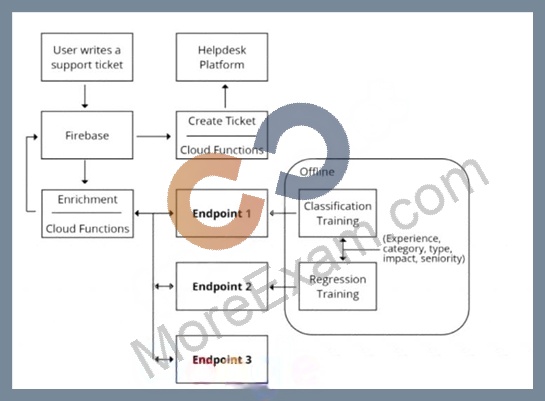
Question74: You are designing an architecture with a serverless ML system to enrich customer support tickets with informative metadata before they are routed to a support agent. You need a set of models to predict ticket priority, predict ticket resolution time, and perform sentiment analysis to help agents make strategic decisions when they process support requests. Tickets are not expected to have any domain-specific terms or jargon.The proposed architecture has the following flow:Which endpoints should the Enrichment Cloud Functions call?
Question75: You have been tasked with deploying prototype code to production. The feature engineering code is in PySpark and runs on Dataproc Serverless. The model training is executed by using a Vertex Al custom training job. The two steps are not connected, and the model training must currently be run manually after the feature engineering step finishes. You need to create a scalable and maintainable production process that runs end-to-end and tracks the connections between steps. What should you do?
Question76: Your data science team has requested a system that supports scheduled model retraining, Docker containers, and a service that supports autoscaling and monitoring for online prediction requests. Which platform components should you choose for this system?
Question77: You need to develop an image classification model by using a large dataset that contains labeled images in a Cloud Storage Bucket. What should you do?
Question78: You are using Keras and TensorFlow to develop a fraud detection model Records of customer transactions are stored in a large table in BigQuery. You need to preprocess these records in a cost-effective and efficient way before you use them to train the model. The trained model will be used to perform batch inference in BigQuery. How should you implement the preprocessing workflow?
Question79: You developed a BigQuery ML linear regressor model by using a training dataset stored in a BigQuery table.New data is added to the table every minute. You are using Cloud Scheduler and Vertex Al Pipelines to automate hourly model training, and use the model for direct inference. The feature preprocessing logic includes quantile bucketization and MinMax scaling on data received in the last hour. You want to minimize storage and computational overhead. What should you do?
Question80: You were asked to investigate failures of a production line component based on sensor readings. After receiving the dataset, you discover that less than 1% of the readings are positive examples representing failure incidents. You have tried to train several classification models, but none of them converge. How should you resolve the class imbalance problem?
Question81: You work at a gaming startup that has several terabytes of structured data in Cloud Storage. This data includes gameplay time data, user metadata, and game metadata. You want to build a model that recommends new games to users that requires the least amount of coding. What should you do?
Question82: You recently deployed a model lo a Vertex Al endpoint and set up online serving in Vertex Al Feature Store.You have configured a daily batch ingestion job to update your featurestore During the batch ingestion jobs you discover that CPU utilization is high in your featurestores online serving nodes and that feature retrieval latency is high. You need to improve online serving performance during the daily batch ingestion. What should you do?
Question83: Your team trained and tested a DNN regression model with good results. Six months after deployment, the model is performing poorly due to a change in the distribution of the input data. How should you address the input differences in production?
Question84: You have trained a model on a dataset that required computationally expensive preprocessing operations. You need to execute the same preprocessing at prediction time. You deployed the model on Al Platform for high-throughput online prediction. Which architecture should you use?
Question85: You work for an online grocery store. You recently developed a custom ML model that recommends a recipe when a user arrives at the website. You chose the machine type on the Vertex Al endpoint to optimize costs by using the queries per second (QPS) that the model can serve, and you deployed it on a single machine with 8 vCPUs and no accelerators.A holiday season is approaching and you anticipate four times more traffic during this time than the typical daily traffic You need to ensure that the model can scale efficiently to the increased demand. What should you do?
Question86: You work for a retail company. You have created a Vertex Al forecast model that produces monthly item sales predictions. You want to quickly create a report that will help to explain how the model calculates the predictions. You have one month of recent actual sales data that was not included in the training dataset. How should you generate data for your report?
Question87: You are implementing a batch inference ML pipeline in Google Cloud. The model was developed using TensorFlow and is stored in SavedModel format in Cloud Storage You need to apply the model to a historical dataset containing 10 TB of data that is stored in a BigQuery table How should you perform the inference?
Question88: You work for a company that captures live video footage of checkout areas in their retail stores You need to use the live video footage to build a mode! to detect the number of customers waiting for service in near real time You want to implement a solution quickly and with minimal effort How should you build the model?
Question89: You work for a retail company. You have been asked to develop a model to predict whether a customer will purchase a product on a given day. Your team has processed the company's sales data, and created a table with the following rows:* Customer_id* Product_id* Date* Days_since_last_purchase (measured in days)* Average_purchase_frequency (measured in 1/days)* Purchase (binary class, if customer purchased product on the Date)You need to interpret your models results for each individual prediction. What should you do?
Question90: You are developing a training pipeline for a new XGBoost classification model based on tabular data The data is stored in a BigQuery table You need to complete the following steps1. Randomly split the data into training and evaluation datasets in a 65/35 ratio2. Conduct feature engineering3 Obtain metrics for the evaluation dataset.4 Compare models trained in different pipeline executionsHow should you execute these steps'?
Question91: You recently developed a deep learning model using Keras, and now you are experimenting with different training strategies. First, you trained the model using a single GPU, but the training process was too slow.Next, you distributed the training across 4 GPUs using tf.distribute.MirroredStrategy (with no other changes), but you did not observe a decrease in training time. What should you do?
Question92: You are developing a model to help your company create more targeted online advertising campaigns. You need to create a dataset that you will use to train the model. You want to avoid creating or reinforcing unfair bias in the model. What should you do?Choose 2 answers
Question93: You work for a pet food company that manages an online forum Customers upload photos of their pets on the forum to share with others About 20 photos are uploaded daily You want to automatically and in near real time detect whether each uploaded photo has an animal You want to prioritize time and minimize cost of your application development and deployment What should you do?
Question94: You have trained a DNN regressor with TensorFlow to predict housing prices using a set of predictive features. Your default precision is tf.float64, and you use a standard TensorFlow estimator; estimator = tf.estimator.DNNRegressor( feature_columns=[YOUR_LIST_OF_FEATURES], hidden_units-[1024, 512, 256], dropout=None) Your model performs well, but Just before deploying it to production, you discover that your current serving latency is 10ms @ 90 percentile and you currently serve on CPUs. Your production requirements expect a model latency of 8ms @ 90 percentile. You are willing to accept a small decrease in performance in order to reach the latency requirement Therefore your plan is to improve latency while evaluating how much the model's prediction decreases. What should you first try to quickly lower the serving latency?
Question95: You recently deployed a pipeline in Vertex Al Pipelines that trains and pushes a model to a Vertex Al endpoint to serve real-time traffic. You need to continue experimenting and iterating on your pipeline to improve model performance. You plan to use Cloud Build for CI/CD You want to quickly and easily deploy new pipelines into production and you want to minimize the chance that the new pipeline implementations will break in production. What should you do?
Question96: You are building an ML model to detect anomalies in real-time sensor data. You will use Pub/Sub to handle incoming requests. You want to store the results for analytics and visualization. How should you configure the pipeline?
Question97: You are an ML engineer at an ecommerce company and have been tasked with building a model that predicts how much inventory the logistics team should order each month. Which approach should you take?
Question98: You recently joined an enterprise-scale company that has thousands of datasets. You know that there are accurate descriptions for each table in BigQuery, and you are searching for the proper BigQuery table to use for a model you are building on AI Platform. How should you find the data that you need?
Question99: You are an ML engineer at a travel company. You have been researching customers' travel behavior for many years, and you have deployed models that predict customers' vacation patterns. You have observed that customers' vacation destinations vary based on seasonality and holidays; however, these seasonal variations are similar across years. You want to quickly and easily store and compare the model versions and performance statistics across years. What should you do?
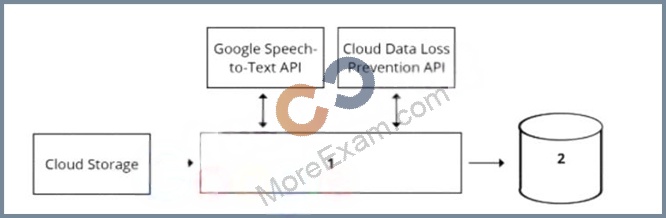
Question100: Your organization's call center has asked you to develop a model that analyzes customer sentiments in each call. The call center receives over one million calls daily, and data is stored in Cloud Storage. The data collected must not leave the region in which the call originated, and no Personally Identifiable Information (Pll) can be stored or analyzed. The data science team has a third-party tool for visualization and access which requires a SQL ANSI-2011 compliant interface. You need to select components for data processing and for analytics. How should the data pipeline be designed?
Question101: You are an ML engineer at a manufacturing company You are creating a classification model for a predictive maintenance use case You need to predict whether a crucial machine will fail in the next three days so that the repair crew has enough time to fix the machine before it breaks. Regular maintenance of the machine is relatively inexpensive, but a failure would be very costly You have trained several binary classifiers to predict whether the machine will fail. where a prediction of 1 means that the ML model predicts a failure.You are now evaluating each model on an evaluation dataset. You want to choose a model that prioritizes detection while ensuring that more than 50% of the maintenance jobs triggered by your model address an imminent machine failure. Which model should you choose?
Question102: You have built a custom model that performs several memory-intensive preprocessing tasks before it makes a prediction. You deployed the model to a Vertex Al endpoint. and validated that results were received in a reasonable amount of time After routing user traffic to the endpoint, you discover that the endpoint does not autoscale as expected when receiving multiple requests What should you do?
Question103: You are building a TensorFlow text-to-image generative model by using a dataset that contains billions of images with their respective captions. You want to create a low maintenance, automated workflow that reads the data from a Cloud Storage bucket collects statistics, splits the dataset into training/validation/test datasets performs data transformations, trains the model using the training/validation datasets. and validates the model by using the test dataset. What should you do?
Question104: You work for a social media company. You need to detect whether posted images contain cars. Each training example is a member of exactly one class. You have trained an object detection neural network and deployed the model version to Al Platform Prediction for evaluation. Before deployment, you created an evaluation job and attached it to the Al Platform Prediction model version. You notice that the precision is lower than your business requirements allow. How should you adjust the model's final layer softmax threshold to increase precision?
Question105: You are developing models to classify customer support emails. You created models with TensorFlow Estimators using small datasets on your on-premises system, but you now need to train the models using large datasets to ensure high performance. You will port your models to Google Cloud and want to minimize code refactoring and infrastructure overhead for easier migration from on-prem to cloud. What should you do?
Question106: During batch training of a neural network, you notice that there is an oscillation in the loss. How should you adjust your model to ensure that it converges?
Question107: You recently joined a machine learning team that will soon release a new project. As a lead on the project, you are asked to determine the production readiness of the ML components. The team has already tested features and data, model development, and infrastructure. Which additional readiness check should you recommend to the team?
Question108: You are a lead ML engineer at a retail company. You want to track and manage ML metadata in a centralized way so that your team can have reproducible experiments by generating artifacts. Which management solution should you recommend to your team?
Question109: You are experimenting with a built-in distributed XGBoost model in Vertex AI Workbench user-managed notebooks. You use BigQuery to split your data into training and validation sets using the following queries:CREATE OR REPLACE TABLE 'myproject.mydataset.training' AS(SELECT * FROM 'myproject.mydataset.mytable' WHERE RAND() <= 0.8);CREATE OR REPLACE TABLE 'myproject.mydataset.validation' AS(SELECT * FROM 'myproject.mydataset.mytable' WHERE RAND() <= 0.2);After training the model, you achieve an area under the receiver operating characteristic curve (AUC ROC) value of 0.8, but after deploying the model to production, you notice that your model performance has dropped to an AUC ROC value of 0.65. What problem is most likely occurring?
Question110: You are working on a classification problem with time series data and achieved an area under the receiver operating characteristic curve (AUC ROC) value of 99% for training data after just a few experiments. You haven't explored using any sophisticated algorithms or spent any time on hyperparameter tuning. What should your next step be to identify and fix the problem?
Question111: You are training models in Vertex Al by using data that spans across multiple Google Cloud Projects You need to find track, and compare the performance of the different versions of your models Which Google Cloud services should you include in your ML workflow?
Question112: You have recently used TensorFlow to train a classification model on tabular data You have created a Dataflow pipeline that can transform several terabytes of data into training or prediction datasets consisting of TFRecords. You now need to productionize the model, and you want the predictions to be automatically uploaded to a BigQuery table on a weekly schedule. What should you do?
Question113: You work for an organization that operates a streaming music service. You have a custom production model that is serving a "next song" recommendation based on a user's recent listening history. Your model is deployed on a Vertex Al endpoint. You recently retrained the same model by using fresh data. The model received positive test results offline. You now want to test the new model in production while minimizing complexity. What should you do?
Question114: You work for a company that manages a ticketing platform for a large chain of cinemas. Customers use a mobile app to search for movies they're interested in and purchase tickets in the app. Ticket purchase requests are sent to Pub/Sub and are processed with a Dataflow streaming pipeline configured to conduct the following steps:1. Check for availability of the movie tickets at the selected cinema.2. Assign the ticket price and accept payment.3. Reserve the tickets at the selected cinema.4. Send successful purchases to your database.Each step in this process has low latency requirements (less than 50 milliseconds). You have developed a logistic regression model with BigQuery ML that predicts whether offering a promo code for free popcorn increases the chance of a ticket purchase, and this prediction should be added to the ticket purchase process.You want to identify the simplest way to deploy this model to production while adding minimal latency. What should you do?
Question115: You are working on a Neural Network-based project. The dataset provided to you has columns with different ranges. While preparing the data for model training, you discover that gradient optimization is having difficulty moving weights to a good solution. What should you do?
Question116: You have recently trained a scikit-learn model that you plan to deploy on Vertex Al. This model will support both online and batch prediction. You need to preprocess input data for model inference. You want to package the model for deployment while minimizing additional code What should you do?
Question117: You are designing an ML recommendation model for shoppers on your company's ecommerce website. You will use Recommendations Al to build, test, and deploy your system. How should you develop recommendations that increase revenue while following best practices?
Question118: You work for a telecommunications company You're building a model to predict which customers may fail to pay their next phone bill. The purpose of this model is to proactively offer at-risk customers assistance such as service discounts and bill deadline extensions. The data is stored in BigQuery, and the predictive features that are available for model training include- Customer_id -Age- Salary (measured in local currency) -Sex-Average bill value (measured in local currency)- Number of phone calls in the last month (integer) -Average duration of phone calls (measured in minutes) You need to investigate and mitigate potential bias against disadvantaged groups while preserving model accuracy What should you do?
Question119: You work on a growing team of more than 50 data scientists who all use Al Platform. You are designing a strategy to organize your jobs, models, and versions in a clean and scalable way. Which strategy should you choose?